The Goldilocks method of design

If you have been following along you know that the sliding seat design was done. The only thing missing was the outriggers for it.  I have had several ideas on how to build these and had drawn several versions, but there is nothing like taking it from the computer screen to wood. It doesn’t always work the way you had in mind!

One my goals in nearly all my designs is to keep is simple so that most anyone can build it. At the same time I don’t want it to look like a backyard project that was thrown together. I want something that looks really good when your done.

VERSION #1 (Too ugly)

I started with a simple and old design for a boomerang shaped wing with two simple supports that would attach to the frame near the feet. On paper it looked OK, not especially attractive but sometimes form just needs to follow function. So I built it, clamped it together it looked promising
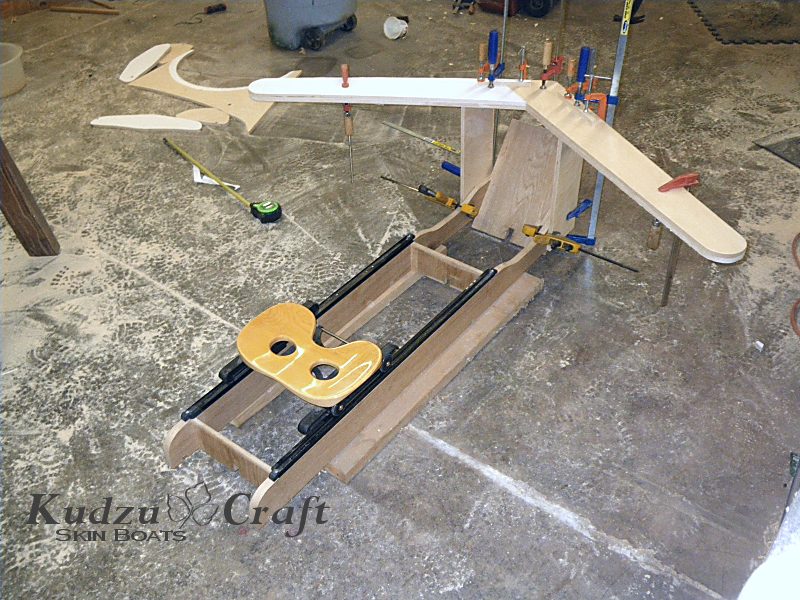
Until I put in the boat!
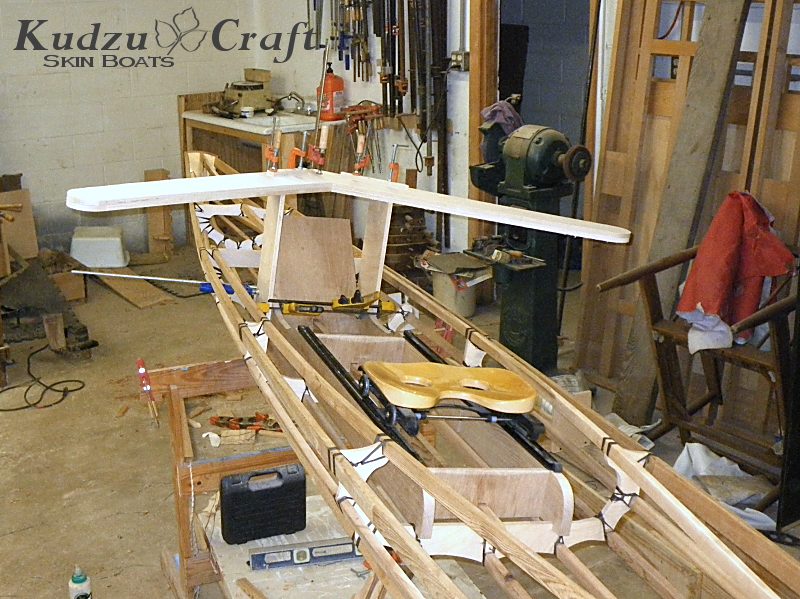
HOLY UGLY DUCKLING, BAT MAN!! That thing looks like it is trying to grow wings and fly!

VERSION #2 (Too hard)

As the old saying goes,”Life it to short to spend it in an ugly boat.”  So this had to go.  Another idea I had played around with was cutting the outriggers into three pieces and joining it together at angles. It would look like a Gull wing and shouldn’t be too hard to build …. so I thought!

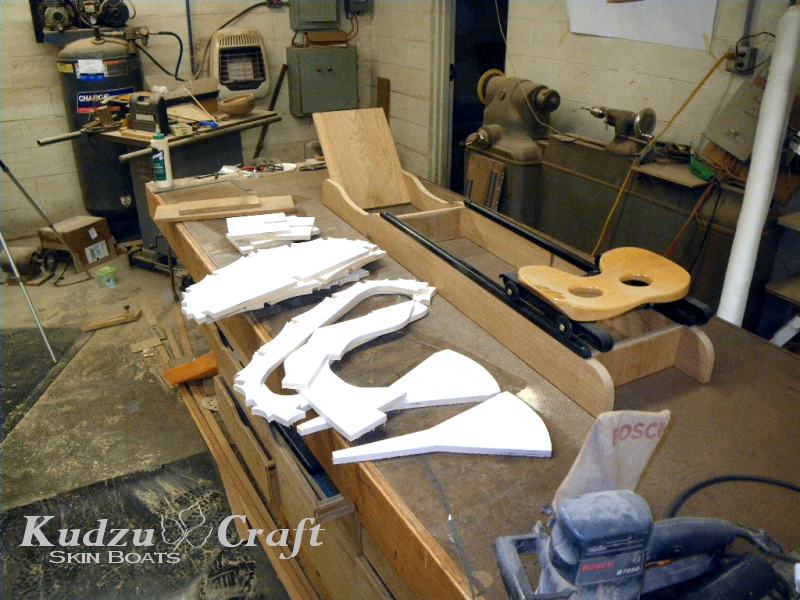
I did some quick layouts, recut the pieces from the first version and started to put it together.
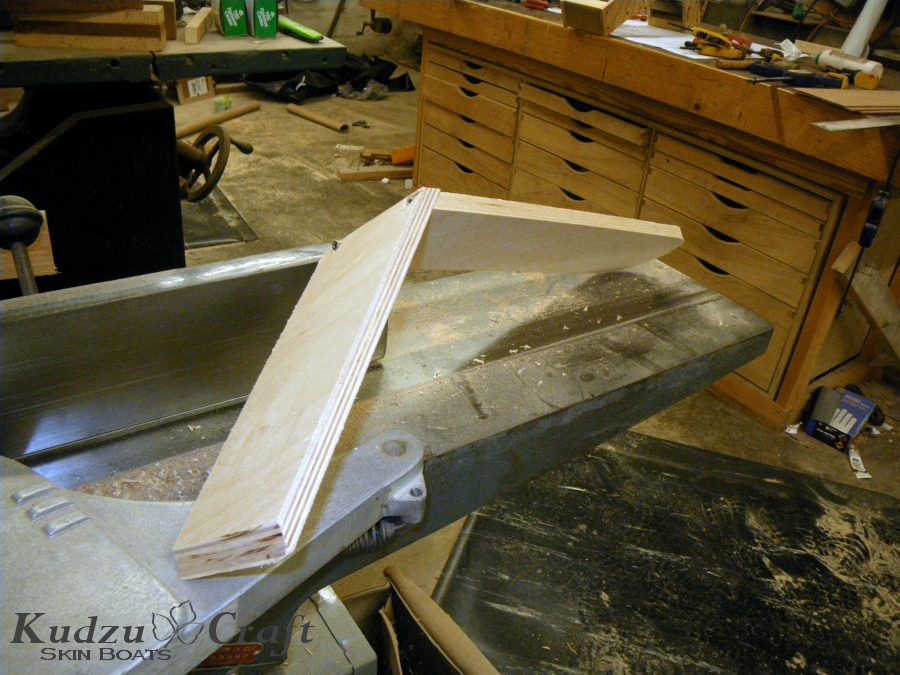
It didn’t take long to realize assembling this was not going to be easy for anyone. By the time all the braces were added to make it strong enough it was going to be a big job to build. Bottom line was there simply was not advantage to this version.

There was really only one good way to build this and I had been trying to get around it.

VERSION #2 (THIS ONE IS JUST RIGHT)

Time to build a form and laminate the outriggers from strips. I was trying to avoid this because I was afraid it was to complicated for inexperienced builders.  I have built a lot of laminated coamings for my kayaks and while they are not particularly hard, they are very aggravating.

To my total surprise this was nowhere near as hard as I had expected. Anyone with any skill could do this. And to think of all the time I wasted trying to get around laminating them.
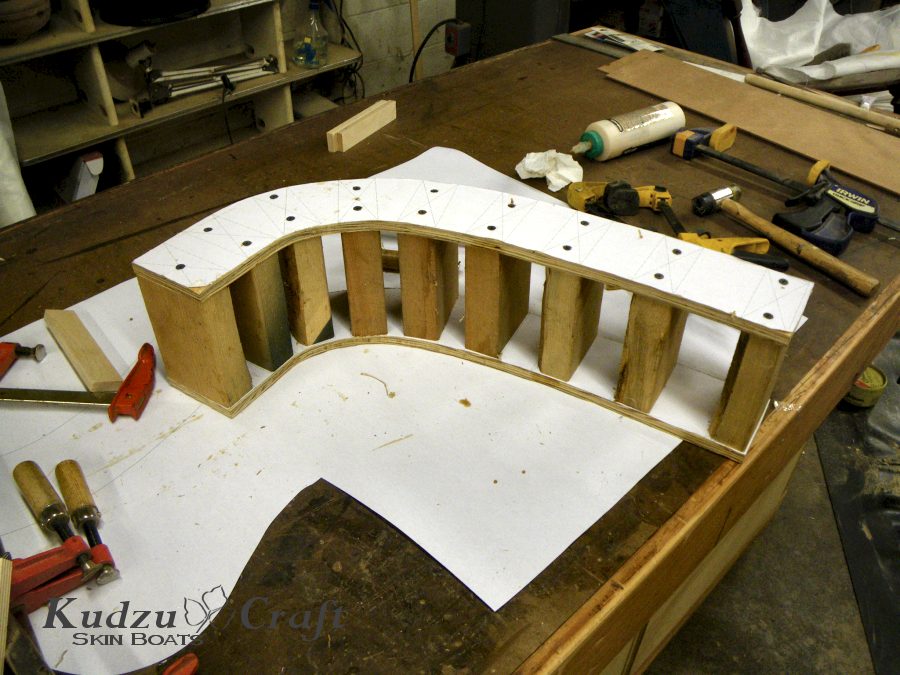
I drew full size patterns. Cut out two pieces of plywood and used short lengths  of 2×4 as spacers and clamping points. These were simply held in place with  drywall screws.

For the lamination’s I used 3mm Okoume plywood ripped into strips. I thought about ordering maple veneer used for making skateboards but I had the plywood in shop and no use for it. So if it failed I wasn’t out anything.  I applied glue on each piece and clamped 6 strips on the jig and started bending and clamping them around the form. I was surprised at how easy it was to bend 6 layers and clamp it in place. A second set of  hands wasn’t necessary but it would have made it easier, but I didn’t have any problems by myself..  I was totally surprised at how fast this went.
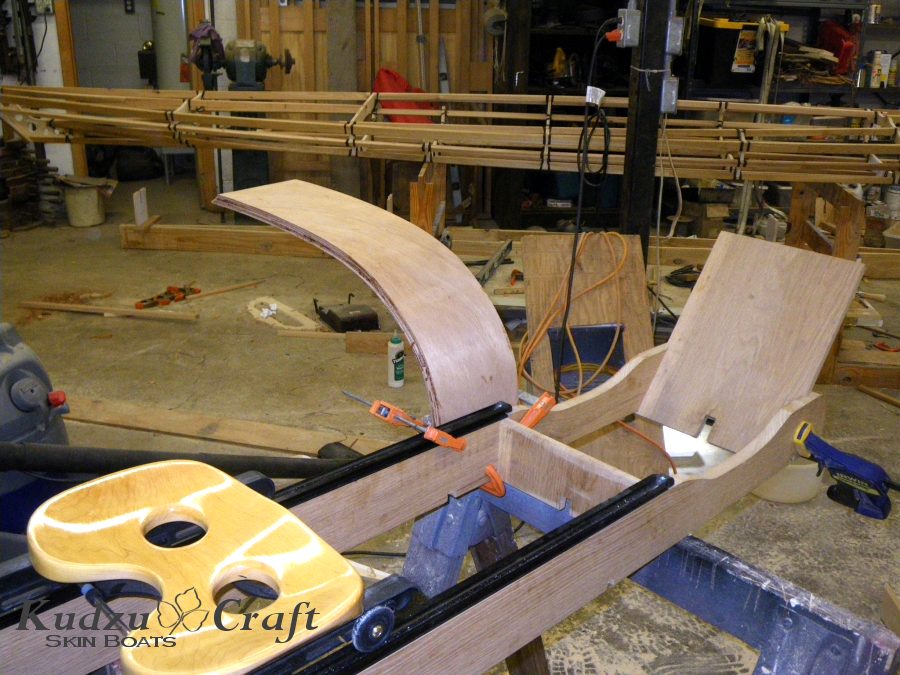
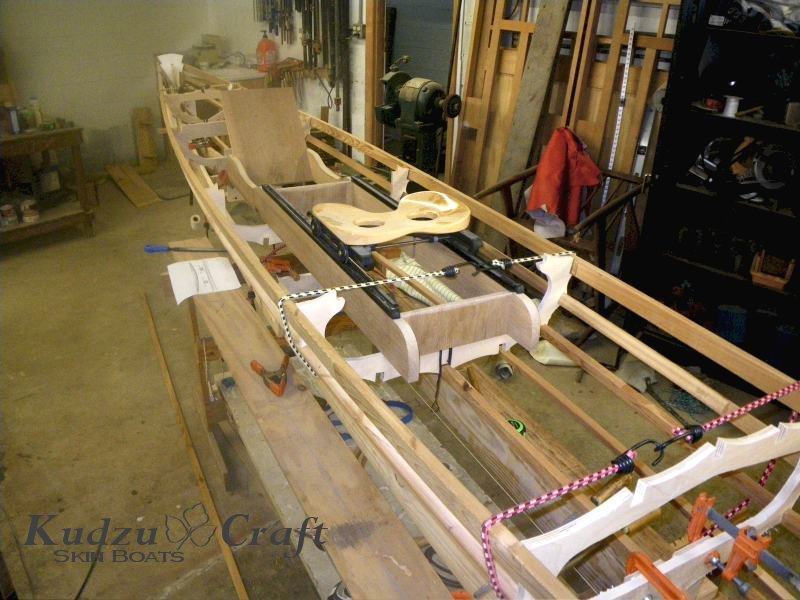
First piece straight off the mold and on to the sliding seat. I had to see what it would look like.

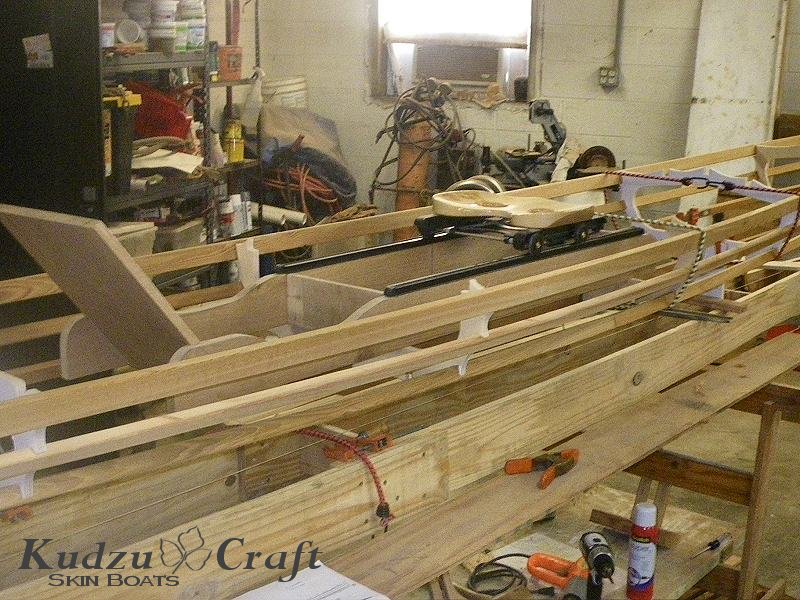
Here it is in the boat.  You can see that is it very close to the seat. I have to add a spacer behind it but that was part of the plan all along. I wanted to make sure that I had the clearance that I expected and that there were no surprises before I did anything else.

I had planned on laminating it to a full inch of thickness but I was surprised at how rigid it was at this thickness. There is going to be some give under a hard pull but since this is a recreational boat and not for competition I don’t think a little flex will be a problem. If I were racing I would want all my energy gong to moving the boat, not bending wood. The good thing is, if this does present a problem, I will build some stronger one and replace them.
 

Small fix for a big problem

As the title implies the fix was simple. Finding it. not so much.

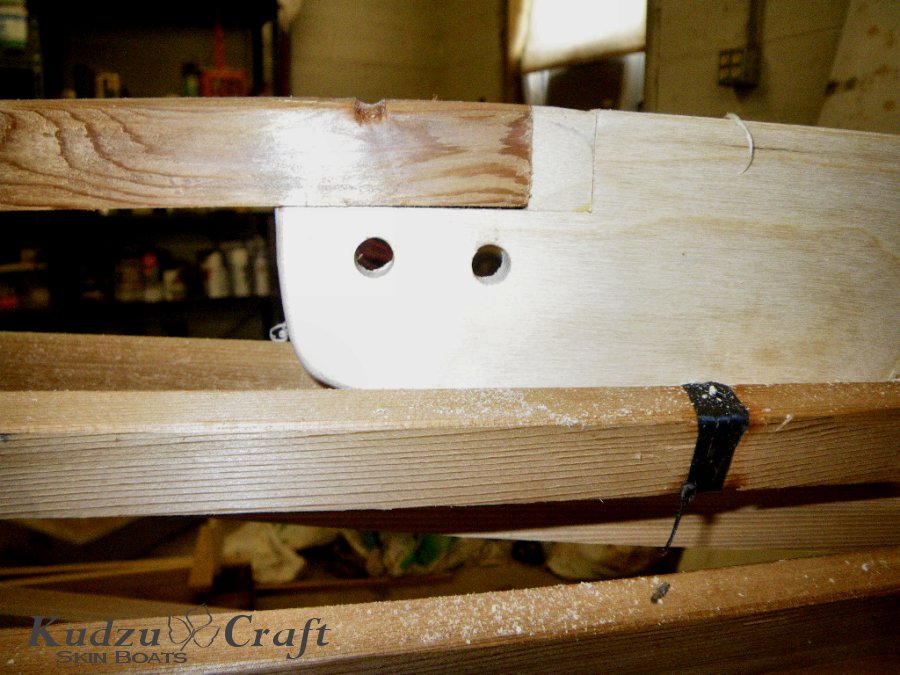
If you look at the end of the keel stringer (boat is upside down in the photo) you will see I added a small block of plywood to the frame. Believe it or not, that made the boat assume a proper shape. Not exactly as I had designed it but it has some rocker in it now. I did find something else that was working against me, but it wasn’t worth the effort it would take to fix it.  Bottom line is I know what I did wrong and how to fix it.

So the frame is done as far as I can tell. It’s stiffer and while not exactly the way I designed it. I am happy with it.  Now it’s time to finish the outriggers for the sliding seat.


Frame is done and we have a problem…

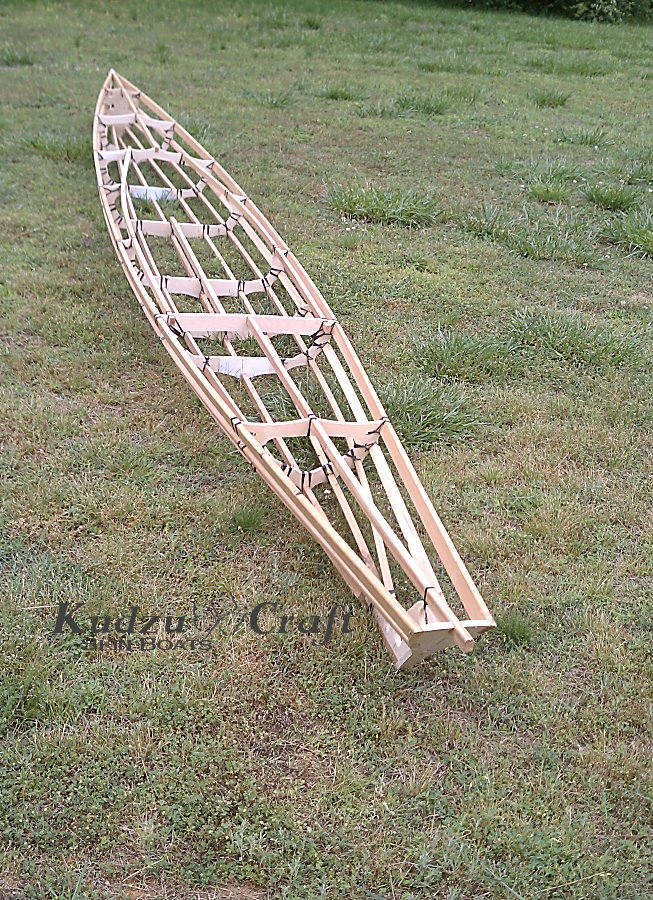
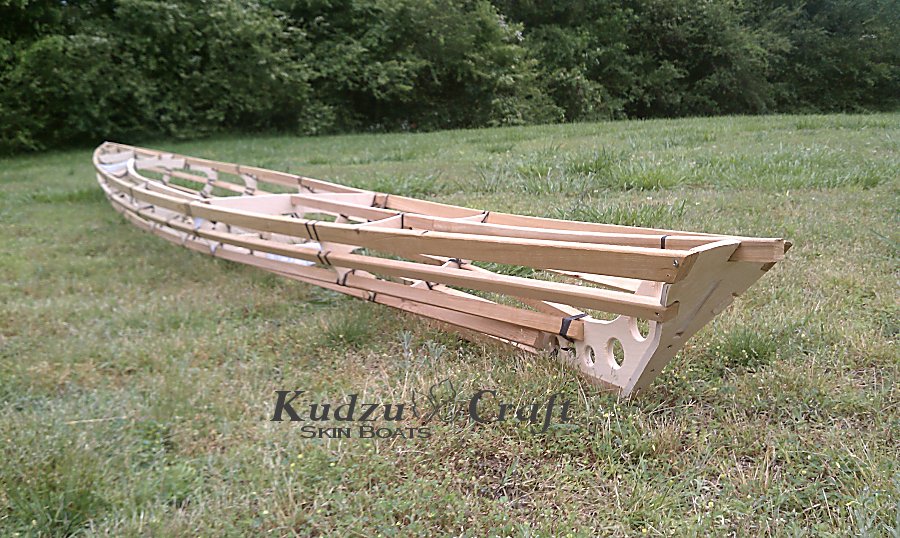
Frame came off the strong back and I took out in the yard for the obligatory F.R.O.G. photo. (frame on the grass)  I still love that raked transom.

I took it back into the shop and placed it on the trailer just to get it out of way so I can clean up around the stands.

I noticed there was more flex in this frame but there is also more wood, so it is heavier and skinning always stiffens them somewhat so it wasn’t a big deal. Then I was on the other side of the shop, turned around and I could see the frame was hogged. No doubt about it, the bow was lower than the center of the boat. I could not  believe it! I took and string and tied it to the boat stretched it along the keel, found that the bow was 1″  lower than the center of the boat.

After a lot of double checking and measuring I still didn’t have an answer, just a couple of ideas. After removing a few lashing, forcing the boat back in shape and studying why it wanted to deform when the pressure was released I have found a couple of reason I suspect are behind this. Of course there is only one way to find out, but that is for the next post.

Still plugging along

Have not made much progress but I am really close to taking the frame off the strongback. Between the ankle and other things going on I just have not gotten to spend the time on this project I really wanted too. But today I finished lashing everything but the deck beams. I needed to scarf some of the cutoffs together to get the lengths I needed for the deck.

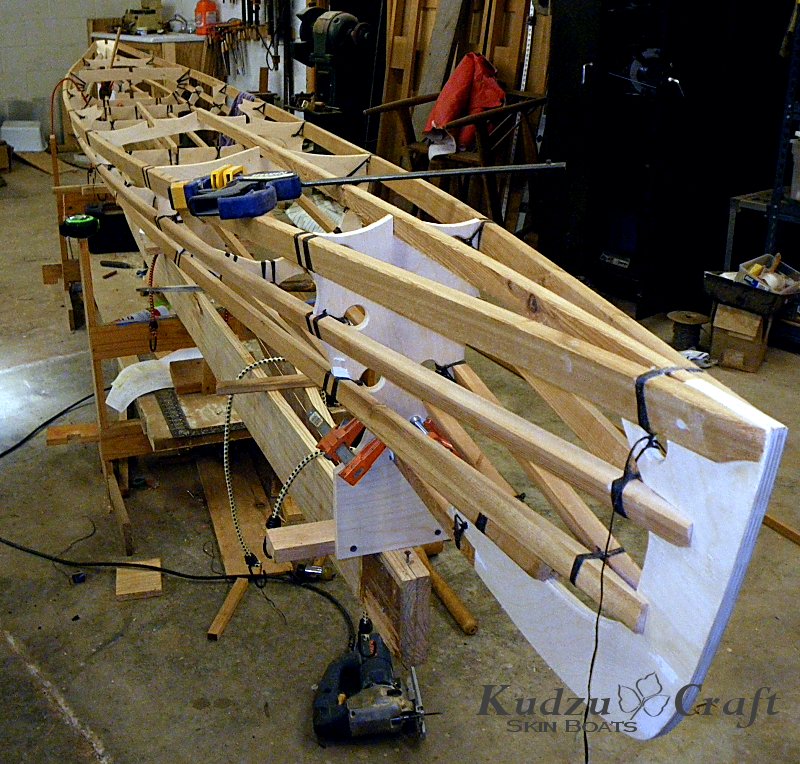
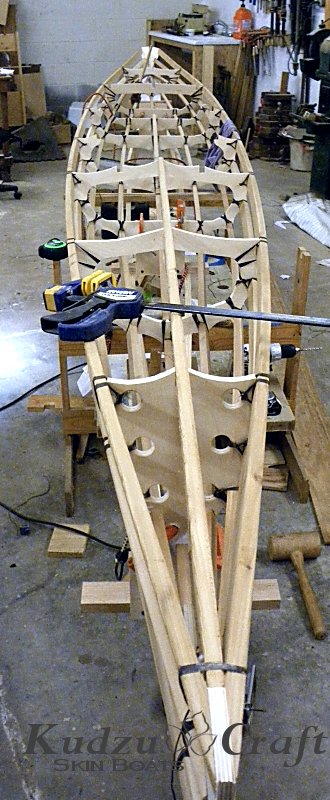
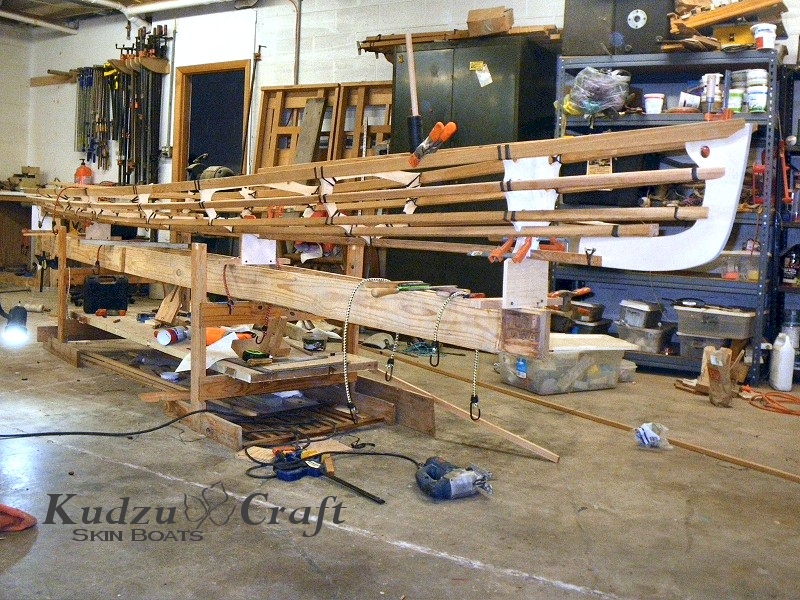
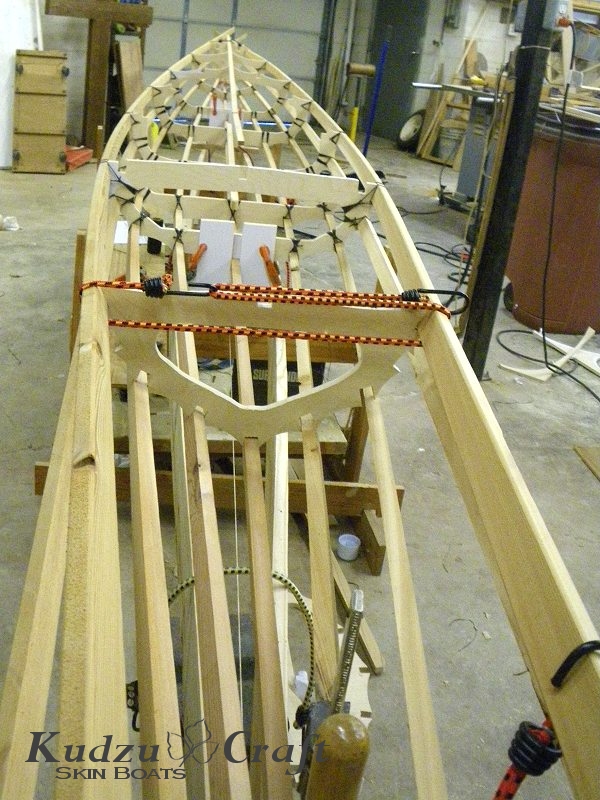
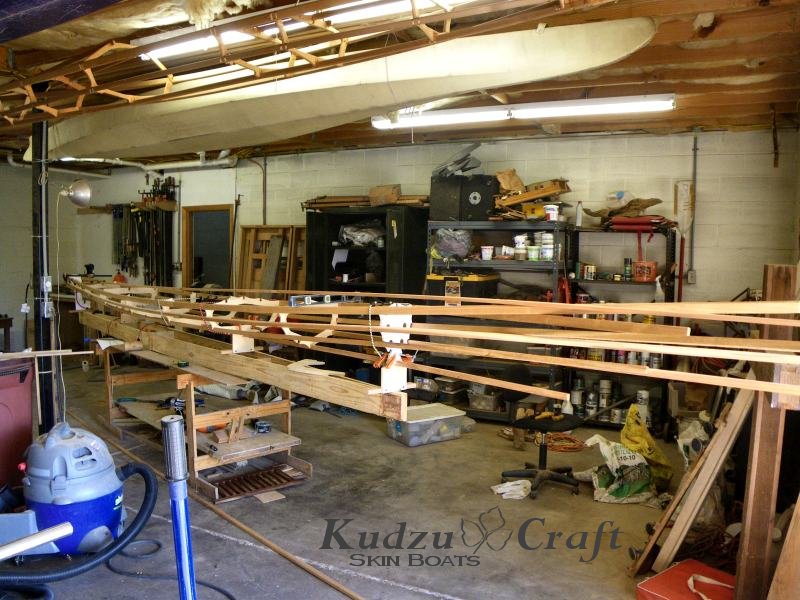
Really anxious to get it off the strongback and flipped over. It’s going to make fitting the transom much easier. Here is a couple of photos. This is a one long boat!


Inch by inch it comes together

Finally, I am able to walk with out holding onto a crutch, cane or whatever was in arms reach. Actually this ankle is healing faster than I expected but boredom has a way  of making time stand still.

It is starting to look a lot like a boat. The hull is getting really close to being done. You can get an idea of its shape in this photo.

Bow is basically finished, just need to trim and lash the gunwales in place.

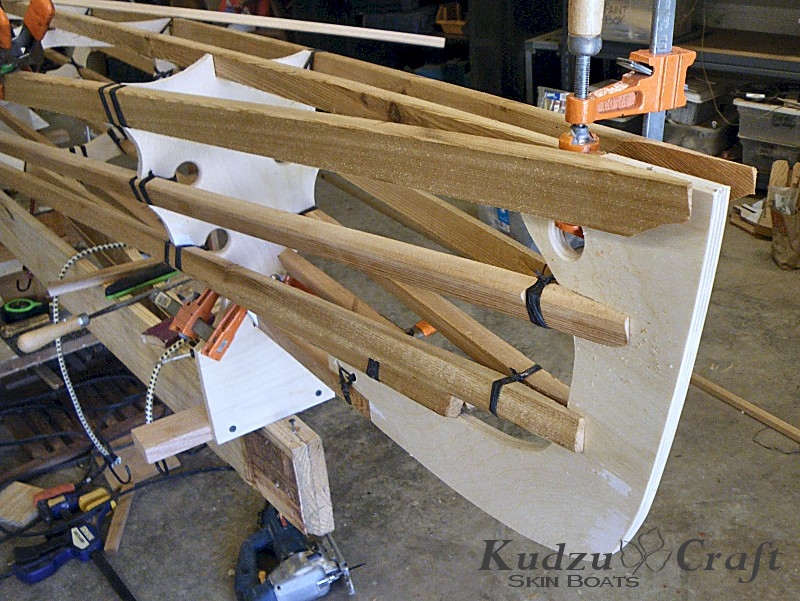
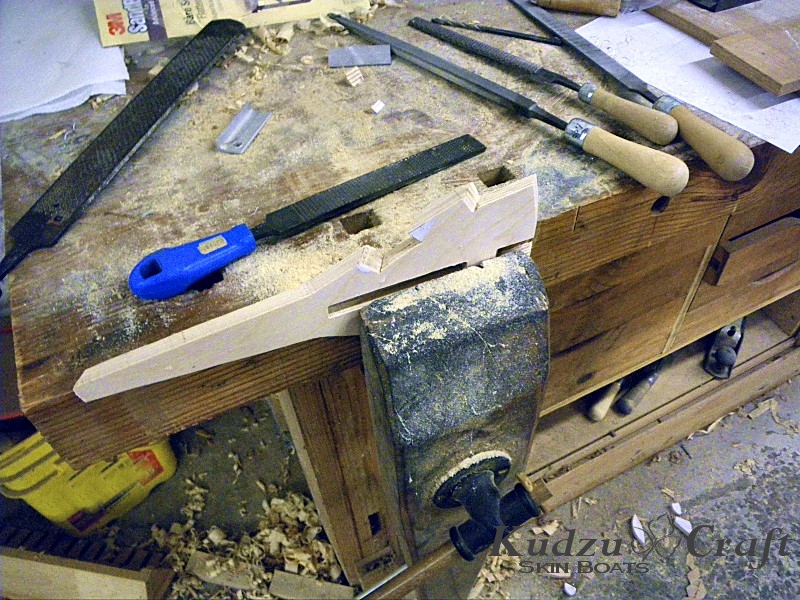
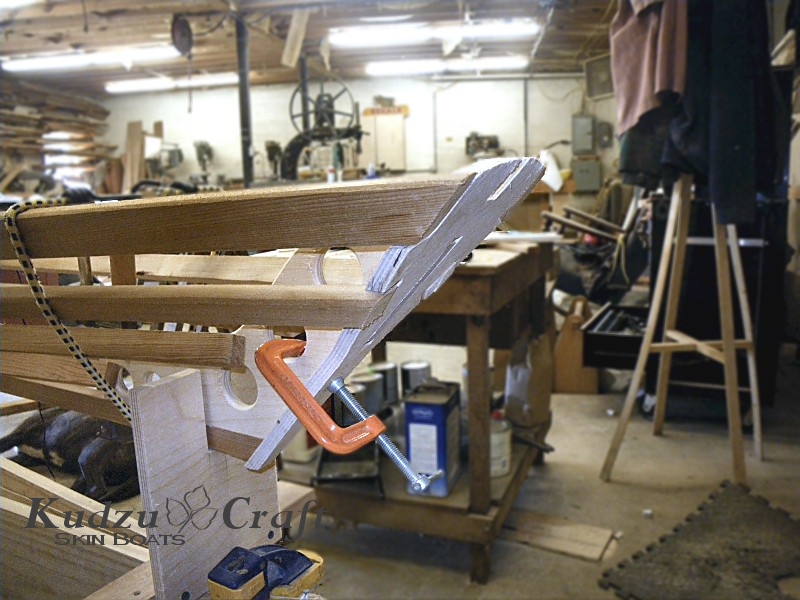
I worked on the transom today. I wouldn’t call it hard but I consider myself a decent woodworker. I suspect it would be challenging if you were not experienced. There was a lot of hand fitting to get everything right.

Put in on the boat, take it off and trim a little. Put in on the boat, take it off and trim a little. Repeat and then repeat it again.

One my most used tools, my bench! Just so much easier to do jobs like this with the proper tool. The best tools for the job don’t always have to be plugged or of charged either.

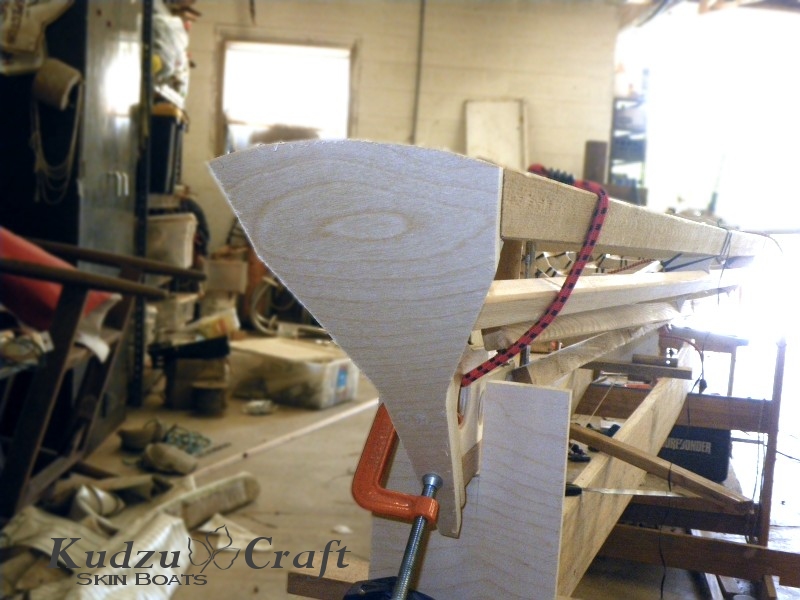
Here the transom is In place with the stringers trimmed. I really love the look of this transom but it is so small it’s not easy to work on.

This will be the finished transom. It needs some trimming and detailing. It will be stained and varnished eventually.  I am considering laminating a nice wood veneer on it. Of course it is it so small and its will barely show due to the rake, it so I am not sure if it is worth the extra effort.

A little more progress

I had an accident and Praise God it crawled away with just a badly bruised, possibly sprained ankle. That has kept me out of the shop for several days now. Swelling is down and I managed to put on my boots and actually lace both up the morning.

I got in the shop a little bit yesterday and got to work on lashing some of the stringers in place. I built the stands I work on and one of the great things is I can can off the top bar and lower the boat down on one of the cross braces. This allowed me to sit in a chair and work. Was nice to be able do something besides watch TV. Trust me, there is nothing on TV!

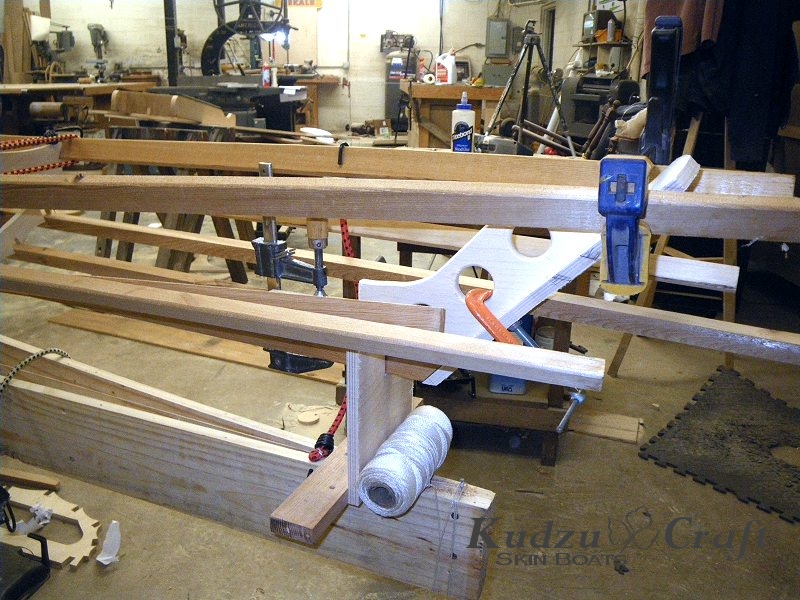
I like to lash the center of the boat together leaving the stringers long on the ends.  Once I have the middle lashed I move to the ends and start on them.

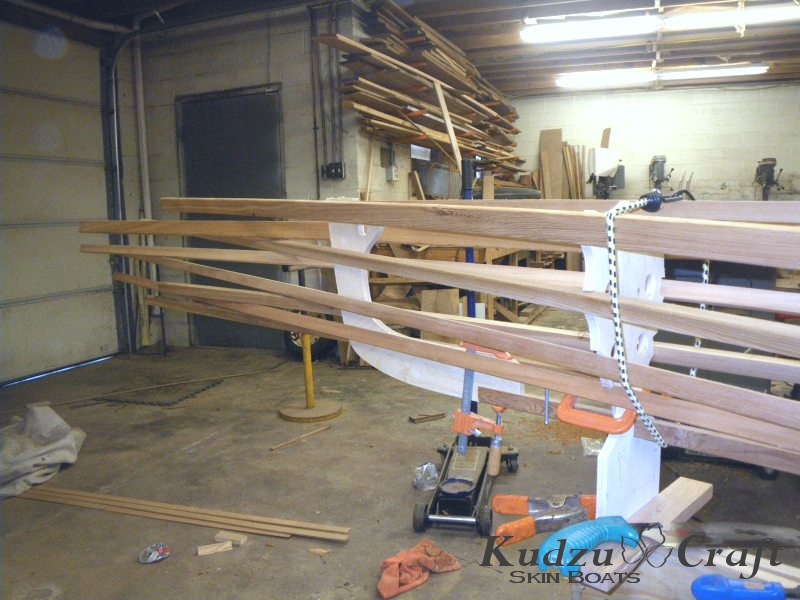
As you can see the stringers were very long on this one. Other than being in the way it’s not a problem and I can use the cutoff by scarfing them together into longer pieces for use on the deck or seat stringers in another boat.

The transom is going to be interesting to build! A little harder than I anticipated but I am not surprised either. Once I get the bow down I will start on it.

Frame starts to come together

It has taken me a couple of days to get back to work on the boat. I have spent a few minutes here and there over the last couple of days. I caught a couple of mistakes and today I finally got most of the frame dry fitted together.

As you can see the stringer are way longer than needed. I bought 12 foot lumber and I ripped and scarfed them together. They end up being 23 feet (+/-) long. Other than being in the way being to long isn’t a problem. After I am happy with what I have and lash the frames in place I will trim them back. I always save the cutoffs because they can scarfed together to make longer pieces.

I couldn’t resist putting the rowing unit in the boat once I got the stringers in place the bungees tight.


Placing it in the boat helped me see what I had but left me with about as many questions as answers. Still not sure how I am going to mount it to the boat. Looking at it I came up a couple of ideas that might work. Also thinking I need one more partial frame to support the unit.

From this angle  I could see that I could shave an inch off height off of the rowing unit frame. That will lower the center of gravity and making the boat a lot more stable.  There is enough space under the foot board that I can slide it downward and my heels could actually be below the rowing unit if I wanted. Plenty of room to make it me properly.

Tomorrow I will lash a few frames in place that will not change. But I am think I am going to be pulling some of them out and making some alterations.

Building has commenced

I have got to name this boat.  I am torn between Cotton Row, my initial idea and Cottonwood. What ever the name I started cutting the frames today. Actually I got them cut out, just need to do a little clean up work on them and sand the edges a little smoother for them to be complete.

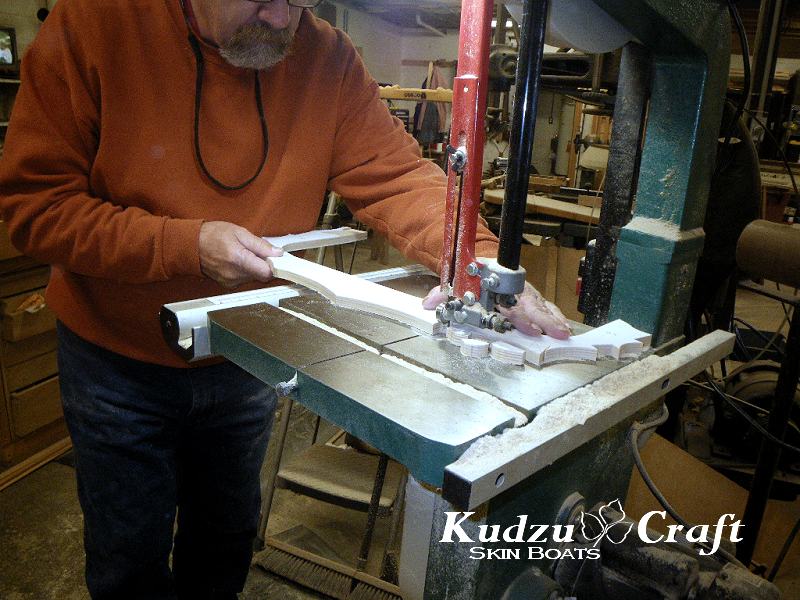
I rough cut them from the plywood with the jig saw and do the final cuts on the bandsaw. It’s just the way I prefer. But one thing I hate about the bandsaw is those stupid ball bearing guides! I don’t know why anyone thinks they are an improvement. They scream like a banshee and I just put new ones on it. It’s so loud I have to wear ear protection or I think I would go mad!

Instead of buying new bearings I should have bought the parts to convert it over to cool blocks. It sure would have been money better spent.

Here you can see my prototype sliding seat. I have the base built and dry fitted together. I want to get the frame built and put in the boat before I glued it anything. I want to make sure I like this and I see no reason I wont.

One thing I know I have to change is the looks of the footrest. That big slab may bet totally functional, but it sure is ugly. Not sure what I am going to do but it really needs something!

Now for something totally different

I have been looking at a ‘pulling’ (rowing) boat design for probably two years now. I have played with lots of ideas. I pretty much finished the design on Sweetbriar but just never built it.  Not sure why but I just kept finding myself trying other things. A couple of weeks ago I was bouncing ideas around on the Wooden Boat Forum when I had a new idea.

What if I took one of my previous designs and made it more like a scull. Add a deck with coamings instead of an open boat.  Lowered the profile while trying to keep some traditional styling in the boat. (I am a big fan of traditional boats)

For those of us that are more experienced boaters (read: older) keep some stability since this is for exercise and recreation. Long enough to take advantage of the sliding seat. For use on protected water and but keep the bow tall enough that it can deal with some chop too. Crown the decks to divert water off to the sides.

This is what I ended up with.  If you could see the waterlines it is essentially a double ender. The transom acts as a bit of a rudder and is largely for looks.  The final version has a rounded shape and doesn’t come to point like I show in the drawing. The plan is a to varnish the transom and you could even put a name on there in the traditional manner.

I have started working on the prototype of a drop-in sliding seat rowing unit for this one. I need to get the frame built so I can check the fit and work out some of the details like how I want to mount it to the boat.  I need to come up with a simple-to-build outrigger. That is proving to be a bit of a challenge. I want something that anyone with some basic woodworking skills can build.

Weather is calling for 5 days or rain starting this afternoon. I just made a run to my lumber supplier and picked up a bunch of plywood yesterday. I see a lot of shop time next few days.